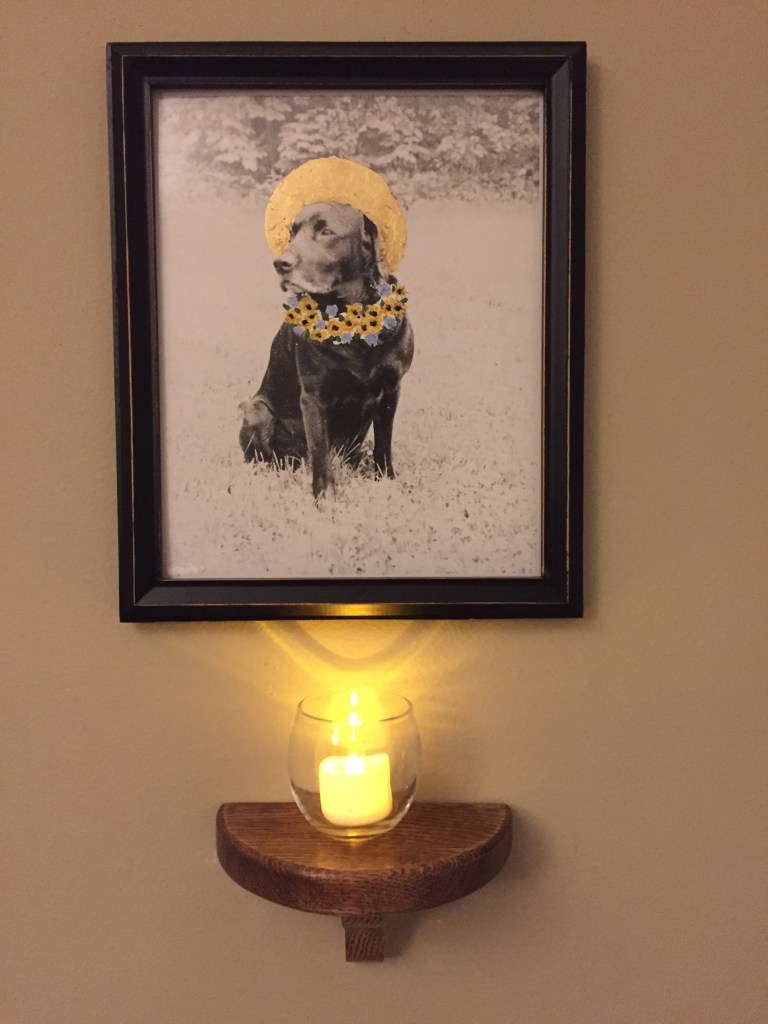
Before he passed away, I painted a portrait of my dog as a saint. With a gold leaf halo and a wreath of flowers. After he passed, I placed an LED votive candle on a small shelf beneath it, always lit in his memory.
My daughter, just learning to speak, points to iconography and asks “Whassat?” I told her, that’s Stanley. He was your brother, our protector, and my soul mate.
I did not know she’d been pointing to his wreath. She calls all flowers by his name
—
Death is the memory of blooming. The scent of fading petals. Not the absence of flowers.
Always depicted as a dark figure waiting to shepherd you home. Never a void of aching desolation.
We speak of death as part of existence, not as its antithesis. Contemplating nothingness would be too fearful.
Humans likely started domesticating dogs around 30,000 years ago. The oldest known intentional domestic dog burial site is in Bonn-Oberkassel Germany, dated 14,200 years ago. A man, a woman, and two dogs rest together.
Ancient Greeks made mosaic memorials and touching poetic epitaphs for their dogs.
“Epitaph to a Dog” is inscribed on the memorial for Lord Byron’s Landseer Newfoundland, Boatswain. The eulogy preceding the poem was written by his friend John Hobhouse and is perfect in its simplicity.
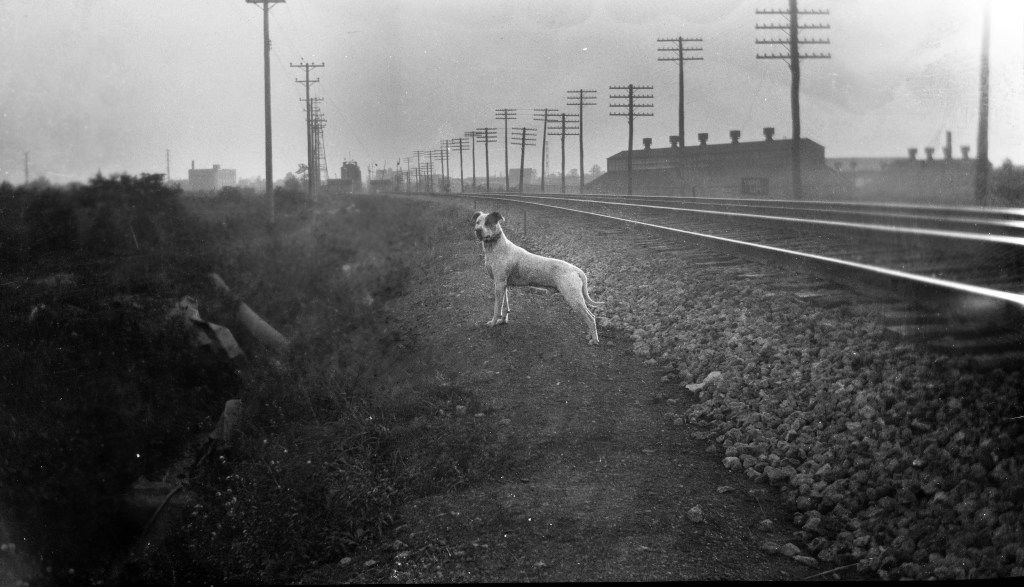
When Lou restored some of my great-grandfather’s photos, two of his dogs are featured. A lab mix and an American bull terrier mix. I’ve included my favorite image below. The bull terrier posing near the Lorain Steel Plant rail-yard.
It has been half a year without sweet Stanley.
It is vital for me to tell you that he was my soulmate.
There is no other word for it. Domestication and symbiosis are too focused on the outcome of obedience and usefulness in a relationship.
We were simply meant to trust and love each other.
There is no timeline for my grief. I have the archeological and historical records to back me up on this.
Since I was 25, Stanley has alleviated my pain. His absence feels like a massive burden that I simply can’t set down. Allowing myself to feel the intensity of my emotions (rather than attempting to “push through”) has been helpful. Writing has been helpful. So I write!
Much love to you, as always.
—
The last time I visited family in North Carolina, Stanley was with me. It felt nice to have a co-pilot on the nine hour drive. It was hot that summer. 86 degrees by 6AM with 90% humidity. We did our walking before sunrise. Stan dug a hole in the yard, under the trailer, to keep away from the sun.
At night, with the AC cranked, we slept on an air mattress in the home office. I let him sleep next to me, even though it was prohibited. His claws could easily puncture the bed, but nothing catastrophic happened. We rolled toward each other on the center of the mattress. Back to back, spine to spine.
When we left, I scrawled a note on the whiteboard: “Stan was here”, accompanied by a caricature of his giant head.
I visited North Carolina for the first time without him last month. I slept on the same saggy air mattress. I noticed his likeness, still scrawled on the whiteboard.
I plan to continue making this caricature of him when traveling. In the margins of all my notes.

Bringing life into the world is not very different than bearing witness to its end. Even with advanced notice, these events are abrupt, momentous, and terrifying.
I had never been a parent before Stanley. He helped make me a better caregiver, advocate, baker, storyteller, hiker, and friend. He got me out of bed on days when it seemed impossible. He helped me learn that while I was sensitive, I was also brave.
He gave me the gift of trusting my instincts. If the vibes are off, sometimes you have to bail. It doesn’t have to make sense. You don’t have to explain it to anybody. Just get back to a space of safety and love. I think of this often, because I subconsciously scan my environment for his phobias. Plastic bags blowing in the breeze, precariously perched laundry baskets, smoke alarms, and beeps of any kind.
Stanley was a vigilant and gentle older brother to my daughter. He passed just shy of her first birthday and his eleventh. I hope Stan is the dog archetype embedded into her subconscious. That she will carry a notion of his lumbering, loyal, loving energy forever.
The below poems were written at separate times in the past year and retitled to make them a pair. The titles are a way to help me grasp that the events of birth and death are not points on a line, but part of a cycle.
I. GENESIS (For I.)
fear hung about like any operation
the nurse the gurney the sterile halls the blinding metal table the silence before your first breath
fear was never your deep lungs never your cat-like howling
II. TERMINUS (For Stan)
my mind is constantly searching for the shape of you. every shadow, your form in repose. every soft noise, your tread
you must be somewhere outside of my peripheral waiting to break free
Stanley was more like a Newfoundland than a Labrador in that he disliked people being in the water. Herding me back to shore when I waded in Lake Erie. Fetching the stick a few times, spitting it out in the water (out of our reach), and spending the rest of the time sniffing the sand for places to pee. Stanley hated water so much, he even watched over the baby’s tiny plastic whale-shaped tub, frantically nudging us to lift her if she cried.
Stanley also hated dancing to the point where I jokingly called him “The Dad from Footloose.” His face would set in stern disapproval. He would bump into your legs and try to box you into a corner where you couldn’t move about. He would bring toys and blankets to try to distract you. He especially hated it if you had the baby while dancing – he never liked her lifted, twirled, or subjected to any sudden movements. There were many a Whitney Houston “I Wanna Dance with Somebody” pandemic work-from-home dance breaks that were shut down because he wasn’t having it.
He didn’t really like singing, either. Before the tumors spread, and he could sleep comfortably on his back, I would frequently cradle him in my arms like a baby. I’d sing pop songs from turn-of-the-millennium boy bands that were popular in my youth. He tolerated it because he liked the attention. He also tolerated the hours of lullabies that stopped his newborn sister from crying.
Stan probably hated hide-and-seek the most. It was short-lived whenever we played, as he quickly became upset. Perhaps he really thought I was lost and in trouble. He would play along for a few seeks, and then frantically headbutt “Stop it!”
The way to get him to locate me the fastest (and to know the hide-and-seek game was afoot) was to belt out the melodic Tarzan vocalization in the aptly named 1985 song “Tarzan Boy” by Baltimora (link below, so you can appreciate the absurdity). It was not a hypothesis that I tested, but something that happened once by chance that stuck.
This impossibly upbeat earworm is still in my musical repertoire. Whenever it comes up on playlists, or spills out of my mouth during late-night pop-folk-traditional-country-hymnal lullaby mashups, I have a few sparkling seconds after the leading:
Oh-oh-oh-oh-oh-oh-oh-oh-oh-oh-oh
where I recall the love and solidarity Stan and I had. The hours of us against the world. The Tarzan Boy call worked to summon him from anywhere in the house. It worked if we were separated by long distances in the forests and swamps of Ohio and Pennsylvania.
The emotion of anticipating hearing him clack up the stairs or burst through the brush does not leave.
I truly believe he would get back to me if we were allowed the honor of playing hide-and-seek one last time.